The headcount you never hired.
Every growing company is full of jobs that need doing and nobody to do them. We do that work. Not software, not audits. The role itself, delivered as a service, with AI doing the volume and a human owning the judgment.
What we believe
For forty years, companies hired specialists to do work that was never really creative. A person to clean the CRM. A person to chase the billing. A person to build the report. The work is real, and it matters. But most of it is pattern matching against a checklist the person memorized years ago.
The checklist was always the value. The human was just how it got delivered.
AI is a better way to deliver the checklist. So the work is being unbundled from the person who used to do it, and sold as the finished result.
The size of the shift
Software was the tip. The work underneath is the iceberg.
We are not early to a small thing. We are early to the repricing of the largest line item in business: the cost of the people who do the work.
How big it is
And it is arriving fast: the agents doing this work grow from about $5 billion in 2024 to $50 billion by 2030, close to 46% a year.
Foundation Capital, 2024; Gartner, 2024; Grand View Research, 2025.
From the source
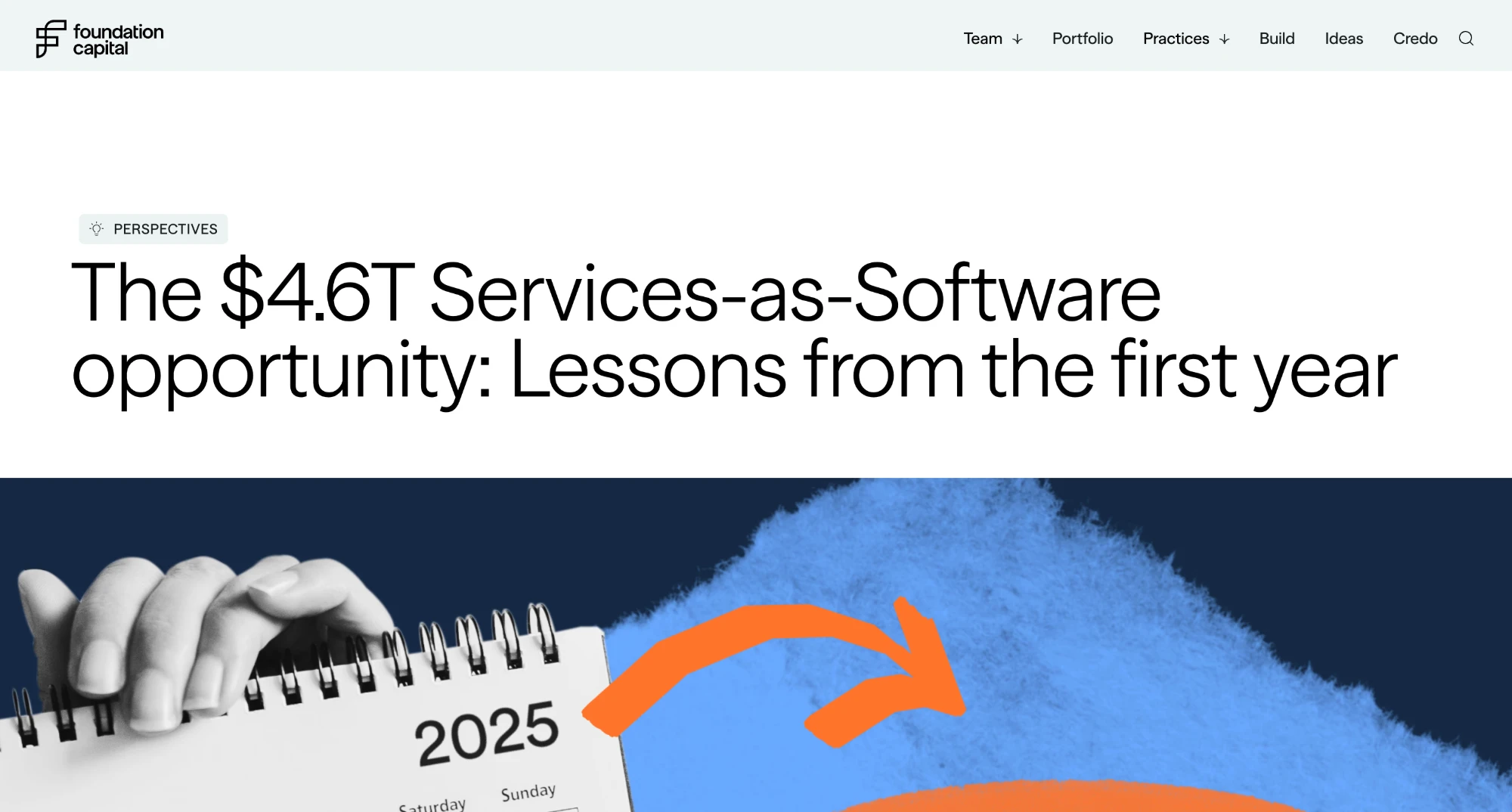
A $4.6 trillion opportunity, since the global services market dwarfs the software market in size.
Foundation Capital, 2024 · read it →
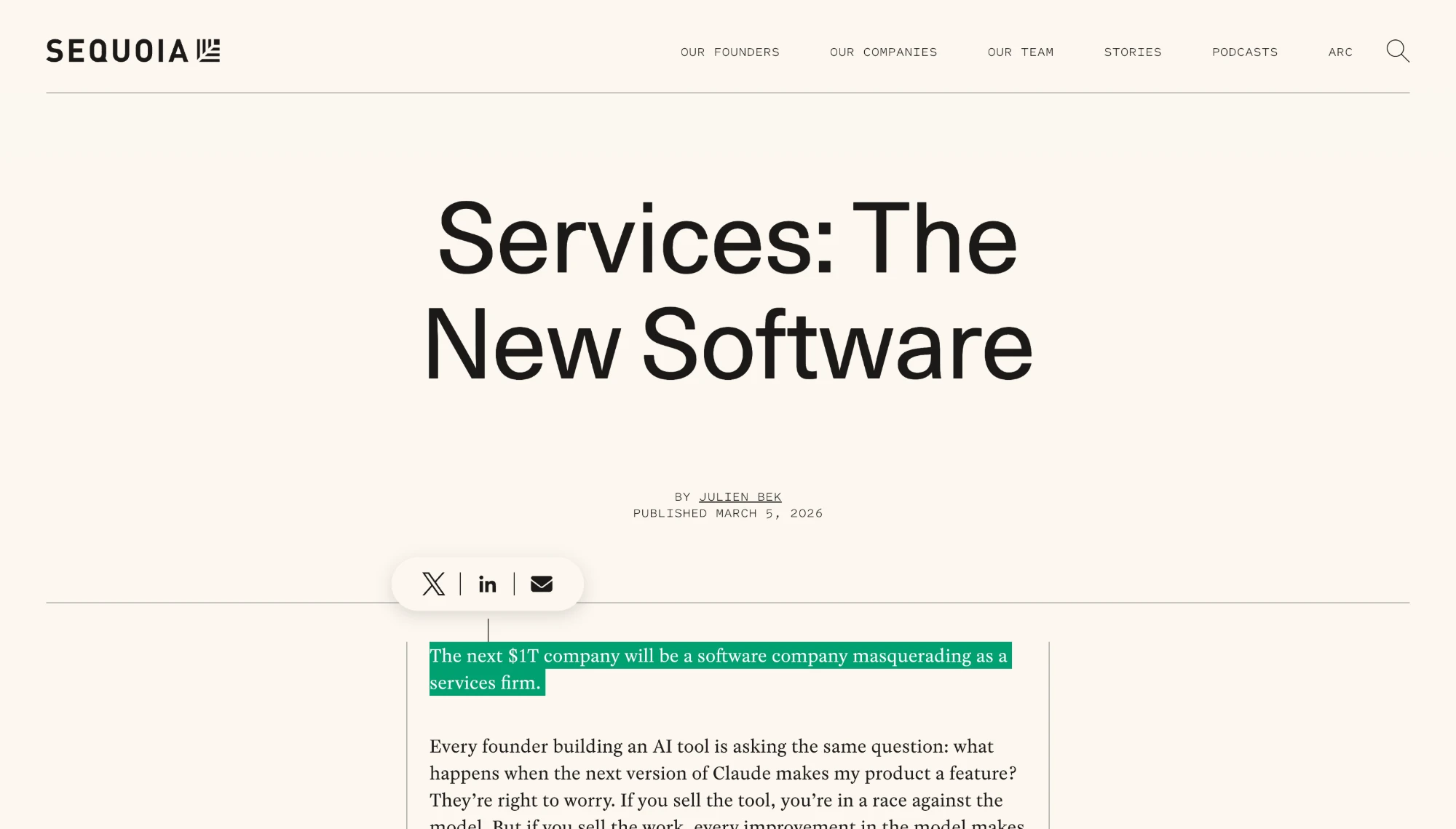
The next $1T company will be a software company masquerading as a services firm.
Sequoia, 2026 · read it →
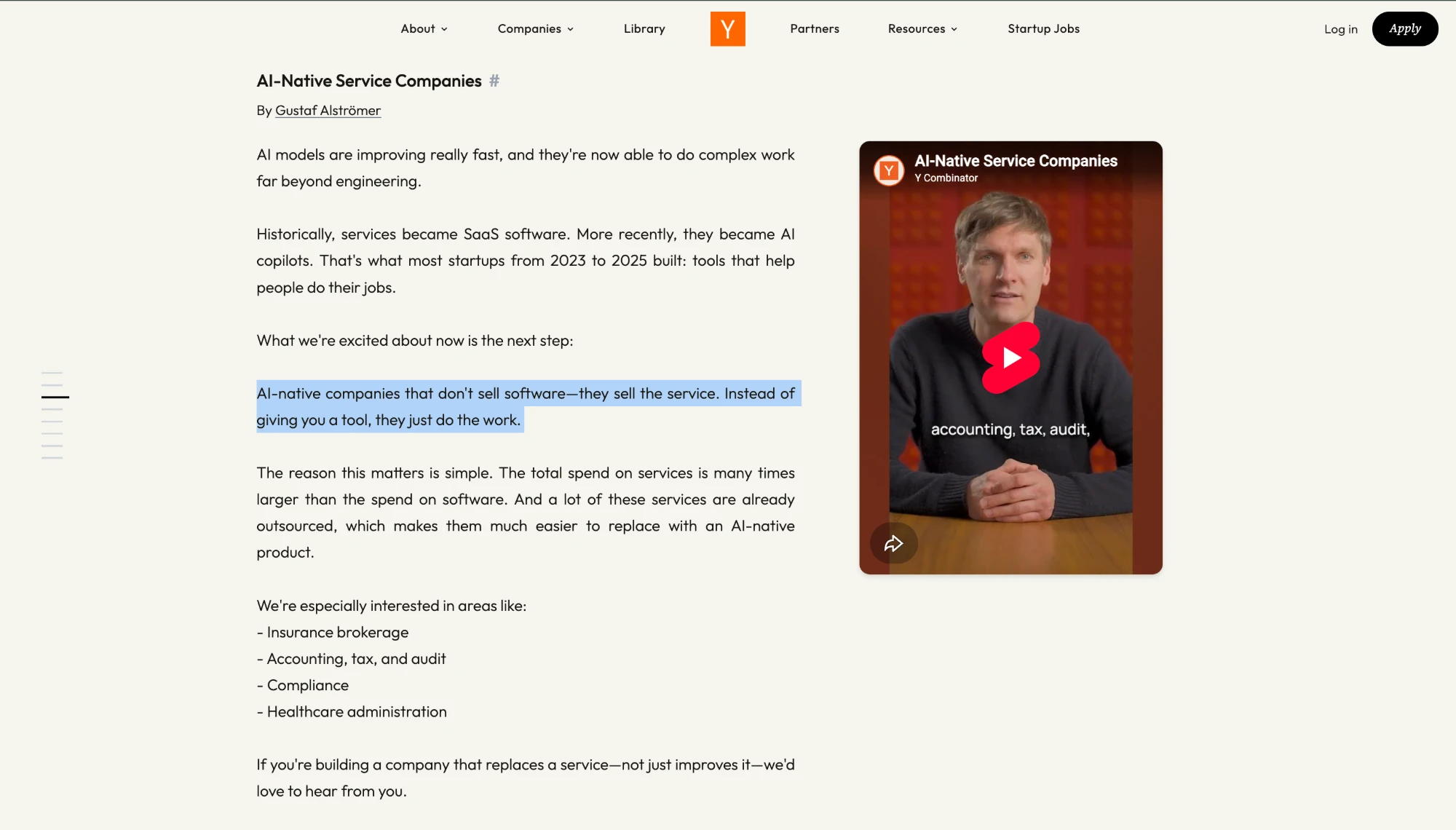
They don't sell software. They sell the service, and just do the work.
Y Combinator, 2026 · read it →
Software is roughly $300 billion. The US labor market is roughly $13 trillion.
Andreessen Horowitz, 2025 · read it →
Why now
The work was always automatable. The machine just got good enough.
This work did not become a rubric recently. It always was one. What changed is that AI can finally run a whole job end to end, accurately enough to trust, and the cost of running it falls every quarter. The capability crossed the line, and the price is collapsing at the same time. That is the window, and it is open now.
What we actually sell
Not a tool. A job, done.
Most companies chasing this build an agent for a tool. We think that is the wrong unit. Nobody hires HubSpot. They hire a person to run it. So that is what we replace. The role, not the tool. The tools sit quietly behind the work, where they belong.
GetHeadcount is the operations team a company never hired. We take a whole job off their plate and run it, end to end. They feel the result, not the machinery.
We do not sell you software to do the work. We do the work.
How the work gets done
A job like this splits cleanly. Most of it is a rubric, the same checks run over and over. So the machine runs the rubric, around the clock, pulling the data, catching what is broken, doing the repetitive work. A human owns the judgment the rubric cannot catch yet, and is accountable when it matters.
Today the human is in the loop on every account. As the rubric matures, that ratio drops. We say so plainly, because the ratio is part of the product.
Why this compounds
It gets harder to replace us with every account.
The rubric is the asset, and it only sharpens. Every account teaches it what breaks and how to fix it, calibrated on real businesses, not demos. A bigger company can copy the idea, but not the years of judgment baked in. That gap widens with volume.
And once we run one role, we are inside the business. Taking on the next role is easy for us and a real switch for anyone trying to displace us. We get stickier with every account, and every role.
Where we start
One role, in one industry.
The operations person a growing staffing firm cannot justify hiring. Candidates and client reqs come in faster than anyone can work them, and the firm loses placements it already won to follow-up that never happened. We run that work, so nothing slips. It is the sharpest pain we could find, in a US staffing market worth about $190 billion a year, and the cleanest place to prove the model.
US staffing market size: Staffing Industry Analysts, 2024.
Where this goes
The back office is the last thing companies still build by hand.
Every growing company hires the same operational roles to do the same repeatable work, and builds that machine from scratch. It is the biggest cost in business and the most duplicated. We are building it once, and running it as a service.
Start with one role, in one industry. Add the next, then the next. As each one compounds, what we offer stops being a service and becomes infrastructure: the operational layer a company runs on, instead of staffing.
Land
One role
A first engagement. Low commitment, fast proof.
Expand
The back office
Role by role, until a company runs on us instead of hiring.
Live today
Revenue operations
Keeps the pipeline clean and every inquiry worked.
Next
Billing and collections
Chases failed payments and overdue invoices.
Ahead
Reporting and data
Keeps the numbers accurate and current.
Ahead
Lead routing and GTM
Gets every lead to the right person, fast.
Ahead
Support operations
Triage, tagging, and follow up.
The back office you cannot staff.
Already underway. Revenue operations is live, and the rest follows the same path.
Operations becomes something you subscribe to, not someone you hire. That is the whole idea behind the name: the headcount you provision, not the headcount you hire.